Author: Memento Research; Compiler: Felix, PANews
The global economy is in the midst of a structural transformation. As digitization accelerates and artificial intelligence penetrates critical value workflows, the importance of infrastructure has never been higher. Today, industries across all industries need to manage critical assets, decisions, and processes that can impact billions of dollars in an opaque environment. At this turning point, verifiability has become a decisive criterion for trust. The need is obvious: businesses, regulators, and end users need proof that digital processes are executed correctly, securely, and in compliance, not just empty promises.
However, despite this rapid growth, a fundamental gap remains. Currently, there is no purpose-built network that can operate at the scale of global payments with the necessary security, efficiency, and regulatory maturity to match or even exceed traditional financial and corporate infrastructure.
Today's public chains have demonstrated verifiability in narrow, asset-centric scenarios, but verifiability remains largely unattainable across the broader application stacks of traditional industries. The significance of verifiability goes far beyond cryptocurrency, encompassing areas such as cloud, payments, enterprise software, and artificial intelligence. With its differentiated product portfolio and first-mover advantage, EigenCloud is poised to extend its lead in shared security and capture a large, undertapped market. With early certification and established distribution channels, it is uniquely positioned to expand verifiable infrastructure in global payments and other areas.
EigenCloud: Scalable, Programmable Verifiability Infrastructure
EigenCloud aims to build a foundational platform for programmable verifiability: a unified stack that integrates data availability, dispute resolution, and verifiable off-chain computation into a seamless developer experience. At its core, EigenCloud leverages the EigenLayer architecture to modularize cryptoeconomic trust, enabling complex verification workflows to be implicitly bundled into a single, easy-to-use process. The result is a developer-centric platform that makes verification not only possible, but also composable and scalable across industries, applications, and infrastructure layers.
Unified Verifiability Stack
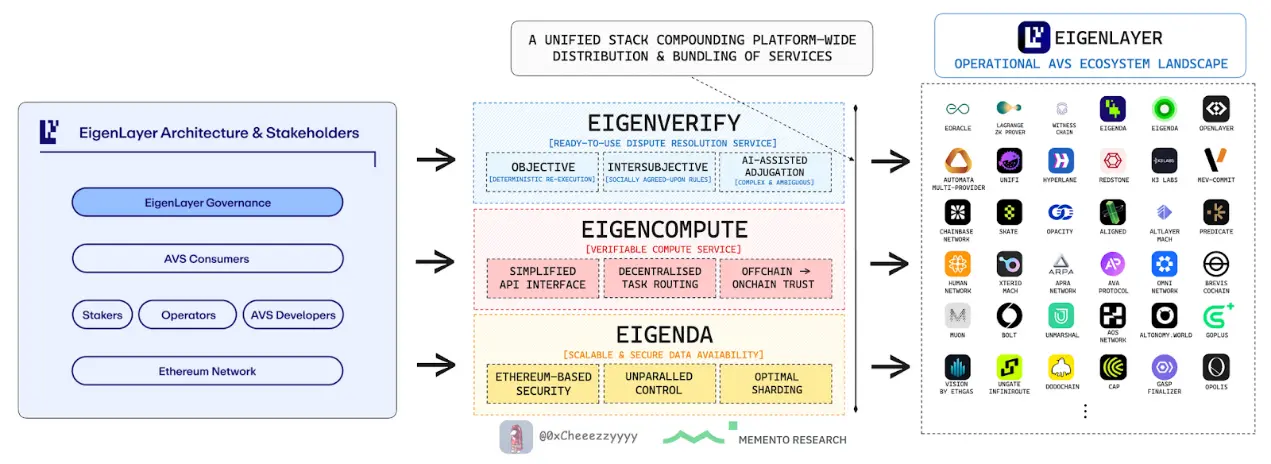
Eigenlayer Complete Architecture Stack
EigenCloud is not just a collection of primitives, it is a coherent verifiability infrastructure. Each of its core modules is designed to solve key bottlenecks in the verifiability lifecycle. However, all modules interoperate natively within the same framework: EigenDA (Data Availability): Provides durable, high-throughput storage for inputs and outputs, enabling independent re-execution and a transparent audit trail. Immutable commitments form the basis for reproducibility and challengeability. EigenVerify (Dispute Resolution): Provides dispute resolution as a service, including objective re-execution, inter-subject consensus, and even AI-assisted adjudication. All outcomes support recourse, ensuring that disputes are finally resolved and economically binding. EigenCompute (Verifiable Off-Chain Computation): Serves as a verifiable container orchestration layer, executing workloads under deterministic wrappers. Security is metered per operation, and third-party AVSs can be combined through a simple, developer-oriented interface. These modules converge into a platform layer of programmable verifiability. EigenCloud unifies these fragmented primitives into a flexible, cloud-native capability that can be directly embedded into existing systems, eliminating the need for developers to piece them together. Implicit Bundling Given EigenCloud's design and architectural foundation, its significant advantage lies in implicit bundling. By unifying data availability, dispute resolution, and verifiable computation within a single stack, EigenCloud provides an end-to-end verification workflow that is seamless by default. This means developers no longer need to manually piece together isolated primitives or manage fragile integrations. Each module naturally flows into the next: data is submitted, claims are anchored, challenges can be raised, and disputes are resolved—all within a coherent flow. As a result, external applications can flexibly integrate any or all of EigenCloud's modules based on their needs while still benefiting from the guarantees of the entire stack. Implicit bundling transforms verifiability from a fragmented practice into a cloud-native feature that's easy to adopt and powerful enough to support mission-critical operations.
Highly Compatible Developer Ecosystem
Furthermore, EigenCloud isn't designed just for cryptographers or protocol engineers. It's designed for maximum inclusiveness. By lowering the integration barrier, EigenCloud enables developers in Web3, enterprise, and AI fields to embed cryptoeconomic trust where it's needed most. Its value proposition is twofold: Simplified end-to-end integration for Web3 developers: EigenCloud provides an end-to-end integration path to minimize the learning curve. Developers can directly access verifiability primitives without having to rearchitect their stack. Monitoring and development tools are built into the AVS DevKit, composable middleware, and orchestration tools. Modular and scalable, suitable for any tech stack: For non-crypto applications, EigenCloud provides modular plug-and-play components. Teams can selectively integrate verifiability in any form factor within their native tech stack without requiring a full migration. This approach aims to bring cryptographic-level trust to both traditional and native AI environments while maintaining architectural flexibility. This inclusiveness is reinforced by strategic partnerships. Google's new Agent Payment Protocol (AP2) marks a major step forward for AI agents as meaningful economic actors. EigenCloud provides the infrastructure for verifiability, ensuring these agents are accountable to any counterparty by embedding VaaS into a wider range of distribution channels and workflows. By combining these two approaches, EigenCloud becomes a universal foundation for verifiability: easy to use for Web3-native applications and equally compelling for enterprises, AI developers, and traditional software builders. Closing the Loop: Practicalizing Programmable Verifiability By combining modular primitives with implicit bundling, EigenCloud transforms verification from a fragmented ideal into a practical and scalable service layer, where complex assurance processes are simplified into a single developer process and trust is composable, programmable, and monetizable across all domains. EigenCloud is therefore not just an infrastructure innovation but also a portal. By making verification accessible to all types of builders, it redefines the fundamental expectation of digital infrastructure: outcomes are guaranteed by proof, not promises. Distribution, Coordination, and Flywheels Its structural leadership is underpinned not only by architectural innovation but also by distribution, first-mover advantage, and the self-reinforcing network effects that accumulate scale over time. At the center of this flywheel is $EIGEN, a native cryptoeconomic asset that aligns the interests of stakers, operators, developers, and enterprises, and represents the rise of programmable trust. Differentiated Market Segments and Distribution Advantages EigenLayer is the first platform to pioneer shared security, formally establishing the new "Trust as a Service" category and spawning the re-staking market, now valued at $28.9 billion. This early innovation not only enables novel use cases but also provides immediate integration and access to capital. EigenLayer holds approximately 66.5% of the re-staking market share, securing nearly $20 billion in Ethereum collateral across over 60 AVS ecosystems. This dominance is driven by long-standing credibility, proven infrastructure, and deep ecosystem support. Unique Dual Distribution Moats and Asymmetric Potential EigenLayer's structural advantage lies in its unique dual moats.
Security as a Service (SaaU): EigenLayer provides a strong shared security foundation, formalizing ETH restaking as a general utility for AVS. This ensures that each new service inherits the security depth without having to rebuild trust from scratch.
Verifiability as a Service (VaaS): EigenCloud extends this model by allowing applications to "rent" verifiability budget across EigenDA, EigenVerify, and EigenCompute. This transforms cryptoeconomic guarantees into a consumable service.
This dual distribution creates an asymmetric growth curve. Each new AVS (whether an oracle, bridge, inference engine, compliance service, etc.) enriches the types and choices of verifiable workflows. As developers build these services, time to market decreases, adoption grows exponentially, and EigenCloud becomes the default backend platform for verifiable applications. This dual foundation kick-starts two mutually reinforcing flywheels: (1) security-driven adoption and (2) verifiability-driven distribution, which together solidify EigenLayer’s dominance.
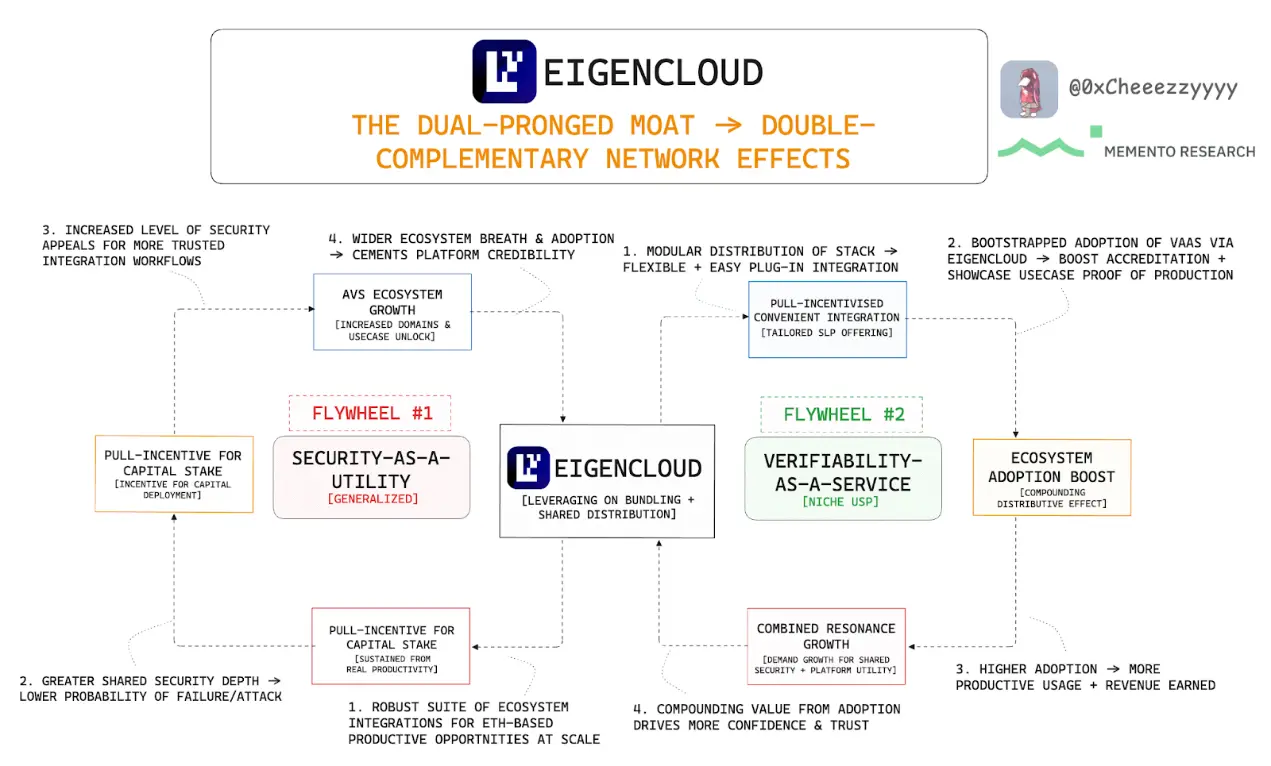
Flywheel 1: Security-Driven Adoption
This is the core growth engine of EigenLayer:
1. Re-staked funds → Shared security pool
When ETH is re-staked to EigenLayer, it flows into a security pool that any AVS can call. New services don't need to build their own validator sets or establish trust from scratch; instead, they can immediately inherit Ethereum's trustworthiness, positioning EigenLayer as a general-purpose marketplace where security itself becomes a readily available utility. 2. Reduced Risk and Cost → Driving AVS Integration The deeper the security pool, the lower the probability of AVS attacks or failures. This reduces both economic risk and operational costs, making EigenLayer an attractive hub for new services to deploy. Developers are drawn to EigenLayer not because they don't have to compete for scarce validators, but because it minimizes the burden while providing Ethereum-level security. 3. Expanded Functionality → More Applications and Liquidity As more AVSs join, they bring specialized functionality, enhancing the ecosystem's composability. This broader toolkit attracts applications and liquidity providers who prefer to build in the richest and most diverse infrastructure environments, amplifying EigenLayer's role as a hub for innovation.
4. Stronger Operator Economics → More Stakers → Higher Security
Each new application joining the ecosystem generates transaction fees and rewards, strengthening operator economics. Higher returns attract more stakers, expanding the ETH security pool and further strengthening the platform's resilience. This creates a self-reinforcing cycle: adoption strengthens security, and stronger security drives adoption, solidifying EigenLayer's position as a shared security layer.
Flywheel Two: Verifiability-Driven Distribution
Building on this secure foundation, EigenCloud drives the second reinforcing flywheel. By bundling verifiability into applications and leveraging EigenLayer's existing network state, it accelerates distribution while strengthening authentication for applications beyond DeFi. 1. Modular Distribution → Rapid Adoption EigenStack and EigenCloud allow projects to tap into Ethereum's validator base and existing distribution channels, avoiding the cold start problem. Instead of slowly bootstrapping trust and usage, applications can immediately achieve scale by leveraging proven infrastructure. 2. Bundling Effect → Attested Trust By embedding EigenCloud's verifiability into application state, projects inherit the credibility and global trust of Ethereum's validation layer. This bundling makes integration easier for businesses, institutions, and regulators without having to provide a separate track record for each new service. 3. Accelerating Integration → Compounding Adoption Each new integration into the EigenCloud stack strengthens the ecosystem's appeal and credibility. As developers, businesses, and institutions gather around the universal validation layer, adoption continues to grow and network momentum builds. 4. Metcalfe Resonance → Consolidation Beyond DeFi As adoption grows across more services, EigenLayer's network effect resembles Metcalfe's Law, with value growing exponentially with each new integration. This not only makes EigenLayer the most powerful shared security layer, but also creates the bundling capability for universal programmable verifiability. Converged Synergy: These two flywheels intertwine to drive exponential growth: re-staked ETH underpins shared security, attracting AVS and applications, while EigenCloud accelerates verifiability and distribution into new markets. Scaled security makes applications viable, and scaled verifiability makes them trustworthy. The two complement each other, forming a two-pronged system where each loop reinforces the other. $EIGEN: Ecosystem Value Capture At the core of EigenCloud is the verifiability token, $EIGEN. It underpins the system by securing AVS, supporting dispute resolution, and monetizing programmable verifiability. Unlike utility tokens tied to specific use cases, $EIGEN represents ownership of the entire verifiability economy—covering data availability, dispute resolution, and verifiable computation.
Platform Positioning and Scale
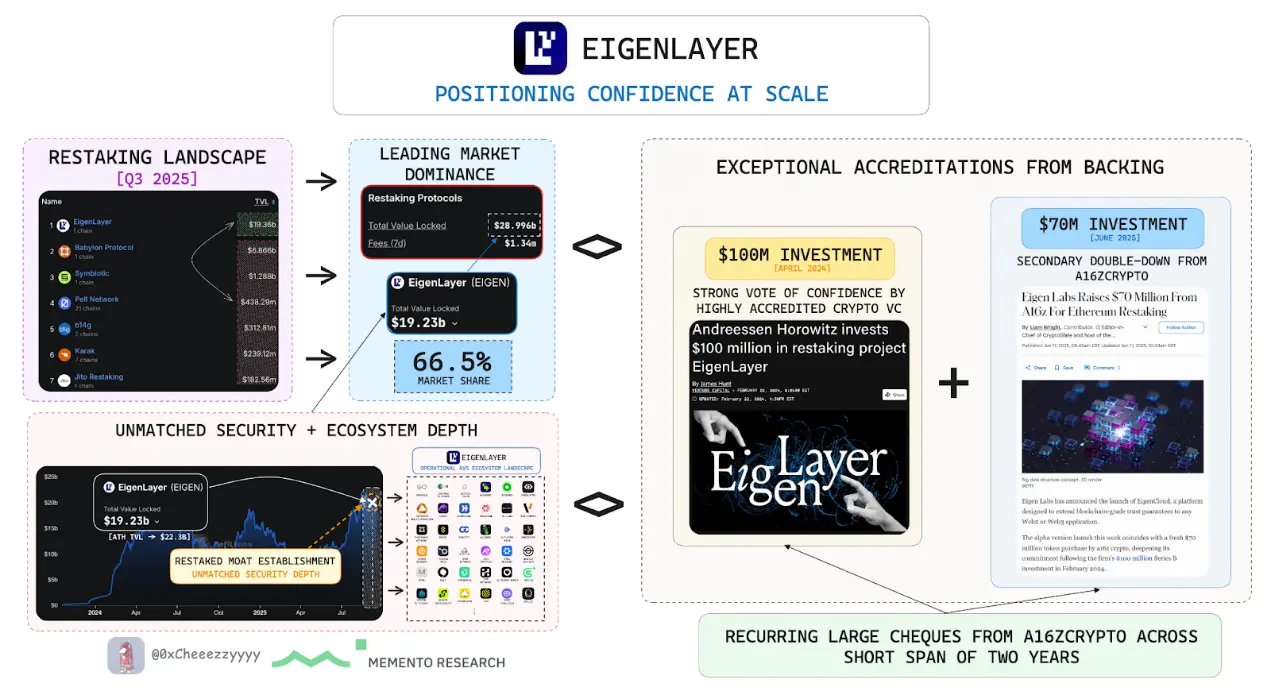
EigenLayer’s dominance in shared security has laid the foundation for $EIGEN in the industry, and its position is further strengthened by platform-wide certifications:
Security and Ecosystem Depth: ~$20 billion in ETH re-staked, ensuring network security, and integrated with 60+ active AVSs, and still growing. Industry Dominance: 66.5% market share in the restaking space. Accreditation and Investor Backing: Backed by $70 million in funding from a16z and recognized by industry leaders. Value Accumulation: A Compound Flywheel Effect. Building on this foundation, $EIGEN continuously accumulates value through a self-reinforcing cycle. More staking expands the cryptoeconomic security pool, making EigenCloud services cheaper and more reliable. Lower costs attract more applications (across DeFi, AI, and enterprise workflows) that embed verifiability into mission-critical operations. As usage grows, fees compound, generating a lasting revenue stream, improving operator economics and incentivizing further staking. Each cycle reinforces the next: deeper staking leads to cheaper services, cheaper services attract more applications, applications drive usage, usage drives fees, and fees ultimately attract more capital. Over time, this dynamic reinforces $EIGEN's position as the economic pillar of EigenCloud. Multifaceted Value Accumulation for Stakeholders Undoubtedly, $EIGEN's design is at the core of the entire ecosystem, aiming to balance and satisfy the interests of all participants. The combined interests of these stakeholders exemplify how EigenCloud transforms verifiability into a shared economy product, rather than an isolated feature. Through an inclusive incentive mechanism, the network ensures the flow of value in multiple directions while reinforcing the same foundation of cryptoeconomic security. This growth not only expands EigenCloud's adoption but also strengthens its defensibility. A Balanced View: Uncertainty and Risk While its structural advantages are clear, EigenCloud must address a range of risks that could impact its long-term adoption and defensibility. Technical risks, centralization pressures, and regulatory complexity are structural challenges that any network must address and could impact its adoption trajectory. However, these risks are not fatal flaws; they are merely obstacles that need to be overcome. The key test for EigenCloud will be its ability to balance decentralization with institutional needs, proving that the same architecture that unlocks programmable verifiability can also adapt to the operational and regulatory realities of global deployment. Conclusion EigenCloud redefines decentralized infrastructure by prioritizing verifiability as a primary principle. Beyond shared security, they've expanded into programmable, application-centric verifiability, addressing the pressing needs of AI, enterprises, and globally coordinated systems. EigenCloud transforms verifiability from a fragmented ideal into a composable, developer-centric platform. This establishes a unique dual, complementary moat for its SaaU and VaaS offerings, making EigenCloud the default trust layer. By setting a new industry standard for service-level proofs, it has driven widespread adoption across AI, enterprise, and capital markets. At the center of this flywheel is $EIGEN, the foundational asset of the multi-trillion dollar verifiability economy and the backbone of tomorrow's high-stakes digital infrastructure.


 Miyuki


