AB 即将上线 Bitget 创新区和 Web3 区,迎来全球生态发展重要里程碑
AB 代币即将于3月3日正式上线 Bitget (bitget.com)交易所创新区和 Web3 区,这是 AB DAO 生态在全球交易渠道拓展的又一个重要里程碑。此次上线不仅将进一步提升市场流动性,还将助力 AB 在 Web3 领域的广泛应用。
 Alex
Alex

Author: fejau, crypto researcher; Translator: AIMan@Golden Finance
I want to write about a question I've been thinking about: How will Bitcoin perform when it undergoes an unprecedented major shift in the pattern of capital flows? I think it will usher in an incredible trade once "decentralization" is over. In this article, I will break down my thoughts. Let's get started.
I will take Michael Howell's research on the historical drivers of Bitcoin's price movements and then use this research to further understand how these cross-trends will evolve in the near future.
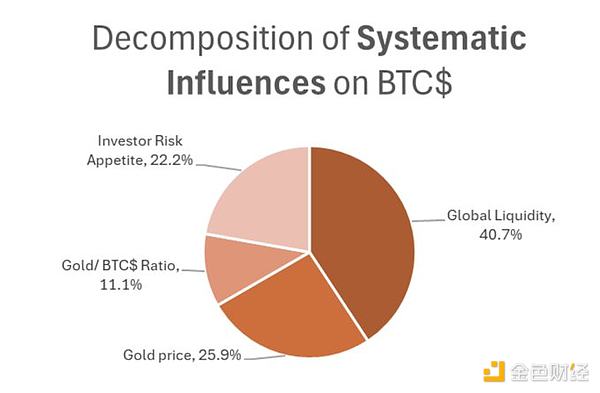 As shown in the above figure, the drivers of BTC include:
Investors are generally interested in high-risk high-beta assets
Correlation with gold
Global liquidity
Since 2021, the simple framework I have developed to understand risk appetite, gold performance and global liquidity is to focus on the fiscal deficit as a percentage of GDP , which has been rising since 2021.
Higher fiscal deficits as a percentage of GDP inevitably lead to higher inflation, higher nominal GDP, and therefore higher corporate revenues, since revenues are a nominal indicator. This is a clear boon to earnings growth for companies that can enjoy economies of scale.
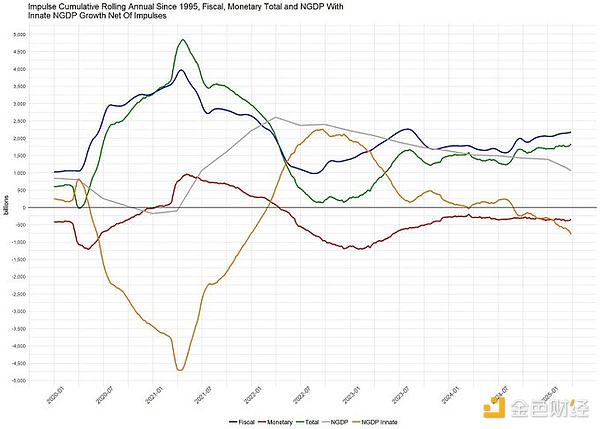
Monetary policy has played second fiddle to fiscal stimulus in most cases, which has been the main driver of risk asset activity. As this chart regularly updated by @BickerinBrattle shows, monetary stimulus in the US has been so muted relative to fiscal stimulus that I will leave it aside for this discussion.
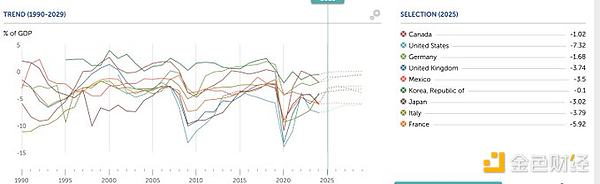
 As we can see in the chart below of the major developed Western economies, the United States has a much higher fiscal deficit as a percentage of GDP than any other country.
 Because the United States has such a large deficit, income growth has dominated and caused the US stock market to outperform other modern economies:
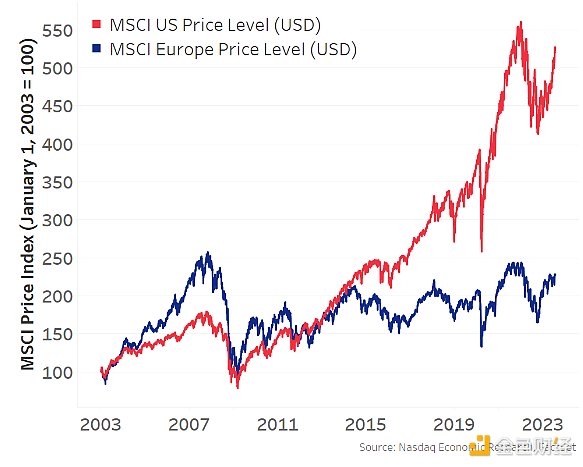 Because of this dynamic, 192);">The US stock market has been the main marginal driver of risk asset growth, wealth effects, and global liquidity, so global capital has flowed to where it can benefit most: the US. Because of this dynamic of capital flowing into the US, combined with a large trade deficit where the US gets goods and foreign countries get dollars, which are then reinvested in dollar-denominated assets (such as US Treasuries and MAG7), the US has become the main driver of all risk appetite around the world:
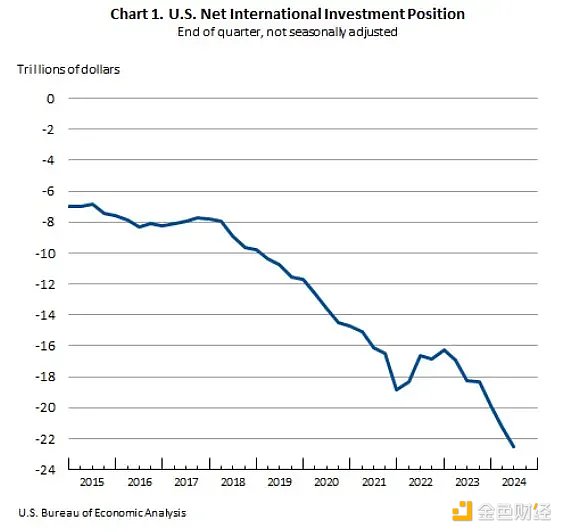
Now, back to Michael Howell’s research above. For the past decade, risk appetite and global liquidity have been mainly driven by the United States, and this trend has accelerated since the outbreak of the COVID-19 pandemic as the US fiscal deficit far exceeds that of other countries.
Because of this, despite Bitcoin being a globally liquid asset (not just the US), it is positively correlated with the US stock market, and this relationship has only gotten stronger since 2021:
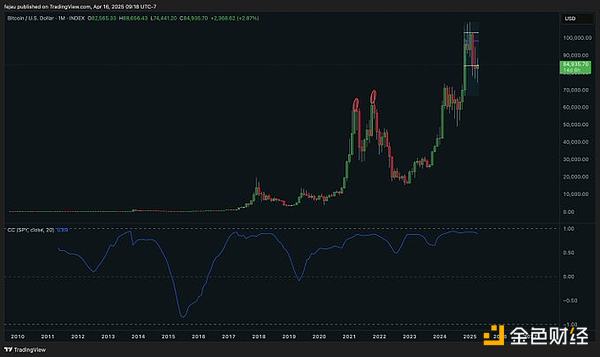
Now, I believe that the correlation between Bitcoin and the US stock market is spurious. I use the term “spurious correlation” here in a statistical sense, because I believe there is a third causal variable that is not shown in the correlation analysis, and this is the real driver. I think it’s global liquidity, which, as we mentioned above, has been dominated by the United States for nearly a decade.
When we dig into statistical significance, we also have to establish causality, not just positive correlation. Fortunately, Michael Howell has also done a great job through Granger causality tests, establishing a causal relationship between global liquidity and Bitcoin:
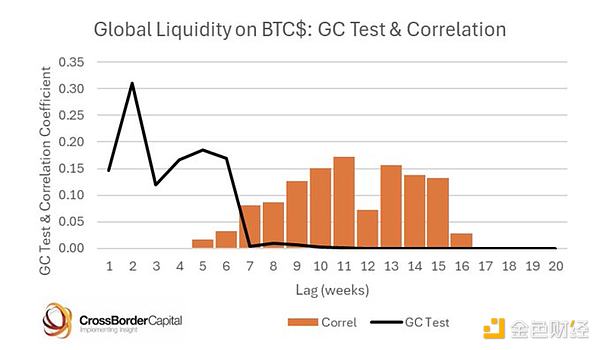 What reference value does this have for us?
Bitcoin is driven primarily by global liquidity, and since the U.S. has been the primary driver of increased global liquidity, a false correlation has emerged.
Over the past month, as we have all speculated on the goals of Trump’s trade policy and the restructuring of global capital and commodity flows, a few dominant views have emerged. I think they are as follows:
The Trump administration wants to reduce trade deficits with other countries, which necessarily means less dollars flowing to foreign countries that are not reinvested in U.S. assets. Without that, the trade deficit cannot be reduced.
The Trump administration believes that foreign currencies are artificially depressed, resulting in an artificially strong dollar, and wants to rebalance this situation. In short, a weaker dollar and stronger foreign currencies will lead to higher interest rates in other countries, which will lead to capital flowing back to the country to take advantage of better foreign exchange adjusted interest rates, as well as domestic stock markets.
Trump’s preemptive approach in trade negotiations is pushing the rest of the world away from (as noted above) tiny fiscal deficits relative to the US and toward investments in defense, infrastructure, and generally protectionist government investment to increase their own self-sufficiency. Whether or not tariff talks eventually cool (except for China), I believe the genie is out of the bottle and countries will continue this quest.
Trump wants other countries to increase defense spending as a percentage of GDP and to increase their contributions to NATO, since the US already pays for most of the cost of NATO. This will also increase fiscal deficits.
I’m going to leave out my personal take on these ideas, as there are already many of them, and just focus on what they might mean if we follow the logic of these narratives:
Capital will leave dollar-denominated assets and flow back to other countries. This means that US stocks will underperform relative to the rest of the world, bond yields will rise, and the dollar will fall.
This capital is flowing to where fiscal deficits are no longer constrained, and other modern economies will start spending and printing money to finance these increased deficits.
As the US continues to move from a global capital partner to a more protectionist one, holders of US dollar assets will have to increase the risk premium on these previously pure assets and must set higher safety margins. This situation will cause bond yields to rise and prompt foreign central banks to seek to diversify their balance sheets away from pure US Treasuries and into other neutral commodities such as gold. Similarly, foreign sovereign wealth funds and pension funds may also pursue this asset diversification.
The counter-argument to these views is that the US is the center of innovation and technology-driven growth, and no country can replace this position. Europe is too bureaucratic and socialist to pursue capitalism like the US. I agree with this view, which may lead to this trend not lasting for many years, but more of a medium-term trend, as the valuations of these technology stocks will limit their upside for some time.
Going back to the title of this article, the first trade to emerge is the sell-off of commonly held USD assets, the ongoing sell-off. Due to the widespread global holdings of these assets, this sell-off can become messy as large fund managers and more speculative investors (such as multi-strategy hedge funds with tight stop losses) hit risk limits. When this happens, we have a margin call day, and all assets need to be sold to raise cash. For now, the goal of the trade is to survive this process and eventually get enough money.
However, as this sell-off subsides, the next trade begins - a diversified portfolio of foreign stocks, foreign bonds, gold, commodities, and even Bitcoin.
On rotational market days and non-margin call days, we are starting to see this dynamic take shape. The dollar index fell, US stocks underperformed other regional stocks, gold soared, and Bitcoin performed surprisingly well compared to traditional US technology stocks.
I believe that as this happens, the marginal increase in global liquidity will turn into the exact opposite dynamic we are accustomed to. The rest of the world will take on the burden of increasing global liquidity, thereby increasing risk appetite.
When I think about the risks of this diversification in the context of the global trade war, I worry about the tail risk of being over-invested in other countries' risk assets because these assets may face some major risks, such as unpleasant tariff news that may affect these assets. Therefore, in this transition, I think gold and Bitcoin are ideal choices for global diversification.
Gold has been in absolute strength, hitting new highs every day, reflecting this shift in the landscape. However, while Bitcoin has performed surprisingly well throughout this shift in the landscape, its beta correlation with risk appetite has been subdued so far, failing to keep up with gold’s outperformance.
Thus, as we move toward a global rebalancing of capital, I believe the next trade is Bitcoin.
When I contrast this framework with Howell’s correlation work, I can see where they come together:
US stocks are not impacted by global liquidity, only by liquidity measured by fiscal stimulus and some capital inflows (but we just established that some of these flows may cease or even reverse). However, Bitcoin is a global asset, reflecting this broad view of global liquidity.
As this narrative becomes more entrenched and risk allocators continue to rebalance, I believe risk appetite will be driven by the rest of the world rather than the U.S.
Gold is likely to perform similarly to Bitcoin, as BTC drivers are also correlated with gold.
With all of these factors established, I see the potential for a decoupling of Bitcoin from U.S. tech stocks for the first time in my history of watching financial markets. I know, it sounds like a "widow maker" that usually marks a local top in Bitcoin. The difference is that this time we are seeing the potential for a major shift in capital flows that will make it last.
So, for me as a risk-seeking macro trader, Bitcoin looks like the cleanest trade outside of the tariff trade here. You can't put tariffs on Bitcoin, it doesn't care what country it's located in, it provides high beta to the portfolio without the tail risk currently associated with US tech, I don't need to take a view on the EU cleanup, and it provides a clean exposure to global liquidity, not just US liquidity.
Bitcoin was born for this market mechanism. Once the dust settles, it will be the fastest horse. Speed it up.
AB 代币即将于3月3日正式上线 Bitget (bitget.com)交易所创新区和 Web3 区,这是 AB DAO 生态在全球交易渠道拓展的又一个重要里程碑。此次上线不仅将进一步提升市场流动性,还将助力 AB 在 Web3 领域的广泛应用。
AlexAB DAO announced that the AB token will officially be listed on Bitget (bitget.com) in the Innovation Zone and Web3 Zone on March 3. This marks another major milestone in AB DAO’s global trading expansion.
AlexOn 7 March, President Trump will host a crypto summit, uniting industry leaders and the President’s Working Group on Digital Assets. Led by AI and Crypto Czar David Sacks, the event seeks to balance regulation and innovation, but skepticism lingers. Will it deliver long-awaited clarity?
 Catherine
Chinese authorities warn of scammers posing as DeepSeek developers, peddling fake tokens and distributing malware-infected apps that compromise user security.
 Kikyo
KikyoJeju police have arrested four individuals in connection with the fatal crypto-related robbery of a Chinese investor. This incident underscores the growing threat of violent attacks on crypto investors driven by the pursuit of digital assets.
CatherineA trader profited $6.8 million from leveraged Bitcoin and Ethereum longs, exiting soon after Trump confirmed a crypto reserve. The timing, with Ethereum longs placed minutes before the announcement, has sparked speculation.
KikyoThe UK Information Commissioner’s Office has launched an investigation into TikTok, Reddit, and Imgur to assess how they safeguard children’s privacy.
CatherineMarch 3, 2025 – AB DAO announced that $AB has been officially listed on Bitget (bitget.com) in the Innovation Zone and Web3 Zone, further expanding its global trading channels and accelerating AB’s adoption in the Web3 space.
Alex为庆祝 $AB 的上线,Bitget 联合 AB DAO 推出了 PoolX & CandyBomb 双重空投活动,覆盖 BGB、BTC、ETH 资产持有者以及充值和交易用户,数万名用户将有机会获得总计 235,502,000 $AB 的空投奖励,价值超过350万美元。
AlexTo celebrate the listing of $AB, Bitget (bitget.com) and AB DAO have launched the PoolX & CandyBomb dual airdrop event, rewarding BGB, BTC, ETH holders as well as deposit and trading participants. Tens of thousands of users will have the chance to win a total of 235,502,000 $AB, valued at over $3.5 million.
Alex